
A Story of Resilience, Courage and Humanity
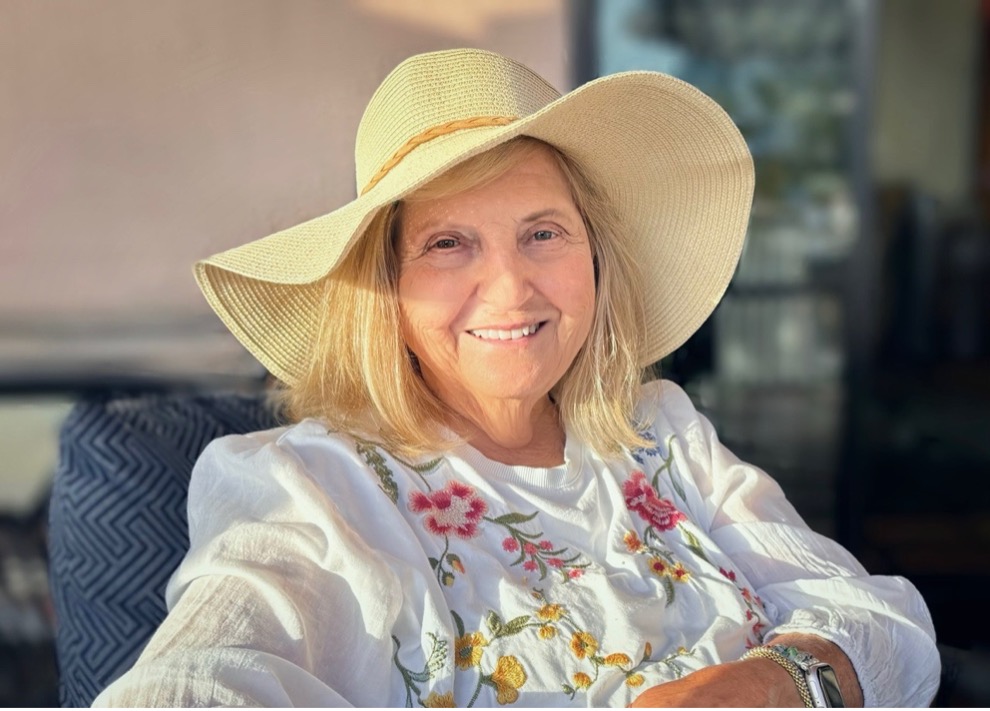
The driveway to longtime SDPA member Midge Coburn’s house is steep and winding. It takes focus, attention, and skill to maneuver a car and reach Midge’s garage. Getting to her home may well be a metaphor for the life Midge has led. Her in-person persona, calm, steady, and focused, may belie a life marked by many obstacles, challenges, and tests of her will and character. She has not followed an easy or conventional path but has led a life of determination, guided by strong values reinforced throughout her life.
Midge has long been interested in people and their lives. As a child in Ontario, California, she loved talking with friends and adults. Not surprisingly, many of her friends sought her company because she listened carefully and cared deeply.
She went to UCLA to study psychology, but she was less than enamored with the experimental psychology courses focused on rat behavior. This wasn’t her calling. She changed her major to sociology, married at 19, and began working as a probation officer. She loved researching people and trying to understand their lives so she could make helpful recommendations. She felt effective in her job because judges often followed her and her colleagues’ recommendations.
Her husband joined the Air Force, and the couple moved across the country, from Arizona to Texas and then to Orlando, Florida, where she had her second child. They later moved to Berkeley and then to Virginia when her husband was hired by the Central Intelligence Agency.
While there, she became interested in Montessori education after placing her children in a Montessori school and introducing the Montessori method at a school serving children with special needs. The children faced a complex array of problems, and Midge found that her methods helped them. As her marriage began to falter, she was asked to write a book about the Montessori method. She eventually divorced and came to San Diego to direct the Aseltine School. She had met her future husband, Bob, an Air Force pilot and a widower, in Virginia. He was eventually stationed in Colorado Springs. An attentive suitor, Bob came to San Diego often and made nightly phone calls. When they married, Midge and her children moved to Colorado to join her husband.
During their time in Colorado, Midge completed a master’s degree and, in three years, a Ph.D. in psychology at the University of Denver. In a typical display of humor and will, Midge told her husband she was going to San Diego for a pre-doctoral internship and asked whether he wanted to join her. They sold their ski house, which they had built from the ground up, and moved most of their children as well. Bob was later very happy with the move, as he enjoyed sailing on the bay.
Once in San Diego, Midge opened a psychology practice in Poway and La Jolla, while her husband worked for General Dynamics. After the children went to college, she and Bob traveled extensively, visiting all the continents and most countries. They toured by bus, car, train, and ship, as adventures dictated.
Midge told me about an experience in Moscow when her travel agent forgot to buy return airline tickets for her and Bob. They were stranded in a place she describes as drab and colorless. After repeatedly bribing officials to get out of the country, the couple was happy to leave Russia via Finland, where Midge actually kissed the ground.
At the onset of COVID, her husband began showing signs of dementia. A stroke and subsequent hospitalization led to stays at two rehab centers that were not providing services, and Bob was declining rapidly. Midge decided to care for Bob at home with the help of two home aides; she formed an effective care team.
Throughout Bob’s deteriorating illness, he kept his “fun-loving” personality. Midge noted that he had been “a wild guy with a fighter pilot personality” he’d never lost, and she continued to love him deeply. Eventually, she arranged hospice care, and Bob died at home two years later. At his moving funeral service, the choir sang “The Wild Deep Yonder,” a fitting tribute to a spirited airman.
I asked Midge what values she thought carried her through a life of challenge and change. It was clear she was flexible, with intelligence and judgment that were well honed and laser-like. She told me she had always learned to treat people with respect and dignity. That resonated with her history, as she’d known so many different kinds of people across cultures and geographies. She had thrived wherever she’d gone.
When she was eight, she was baptized a Mormon at her grandmother’s insistence, though she’s now an Episcopalian. An elder told her to hold her nose as he dunked her in the water. But she thought she knew how to swim underwater and didn’t do that. So he told her she was doing it wrong, to hold her nose this time, and dunked her again. When he pulled her out, he said to Midge, “Now you’re a Mormon.” Her response was, “No, I’m not.” At eight, she knew this wasn’t for her. Her comment reflected her determination and will, and, if you think about it, the courage it took to stand up to a Mormon elder during an important ritual. This will and determination have helped Midge navigate numerous obstacles throughout her life. She’s kind, understanding, and giving, but she is tough and focused. She’s goal-driven in the best possible sense of the word.
In her clinical work, Midge told me she tries to work with the positive qualities in her clients’ personalities. She builds on their strengths and maintains a positive approach.
Midge has always had high standards and is attuned to doing what’s right. This hasn’t always been easy, as Midge has striven to change situations that weren’t right.
In the early years of her marriage to Bob, the blended family experienced a lot of conflict, so Midge flew to California to consult an expert on stepfamilies, whose book she had read. She returned to Colorado Springs on a mission, and over time the families bonded and still are.
When she saw a program for troubled children at a school that wasn’t working, she adopted Montessori methods. Her husband wasn’t receiving adequate care after his dementia and subsequent stroke, so she established a memory care unit at home. She helped Bob live out his final days with love and relative comfort.
A change agent, gifted therapist, woman of adventure, and person devoted to her family and church, Midge Coburn has led a life of consequence, meaning, and purpose.