
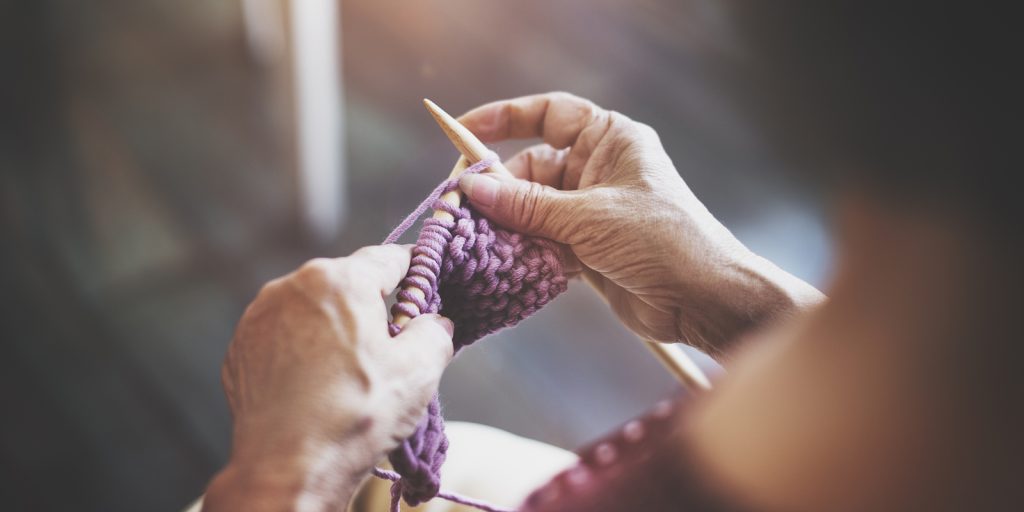
The concept of self-care has become an increasingly popular and accepted phenomenon in American society. Many adults are trying to prioritize recreational tasks, leisure activities, and hobbies to promote their well-being. Included in this culture shift is the promotion of “grandma hobbies” (Lascala, 2025). Under this category are activities such as knitting and sewing, crochet, birdwatching, gardening, baking, coloring, and reading. Behavioral activation – choosing to engage in activities to improve health – has many benefits for older adults (Janssen et al., 2023). Various psychological studies have supported the theory that these “grandma hobbies,” specifically, can increase mental and emotional well-being. Of course, these practices and their benefits can be applied to all of us, though “grandmas” may lead us by example.
Knitting, sewing, and embroidery are all projects that involve motor skills, focus, and a sense of accomplishment. These hobbies can be practiced in an individual setting as well as in a social setting. Knitting among peers has been shown to increase one’s sense of belonging, and the act itself helps one to achieve a sense of competence (Nordstrand, Gunnarsson, & Häggblom- Kronlöf, 2024). The calming effect for those who engage in this hobby can lead to reductions in anxiety, depression, stress, and pain (Nordstrand et al., 2025). These simple tasks can also increase self-efficacy and a sense of control in one’s life when one feels a lack of control elsewhere (Nordstrand et al., 2025). The repetitive movements of the hands and focus on the task have been shown to create a meditative state among knitters, resulting in reduced anxiety, heart rate, and cortisol levels (Meehan, McCulloh, & Schlamb, 2025).
Continue reading “Grandma Hobbies: A Pathway to Health and Happiness”