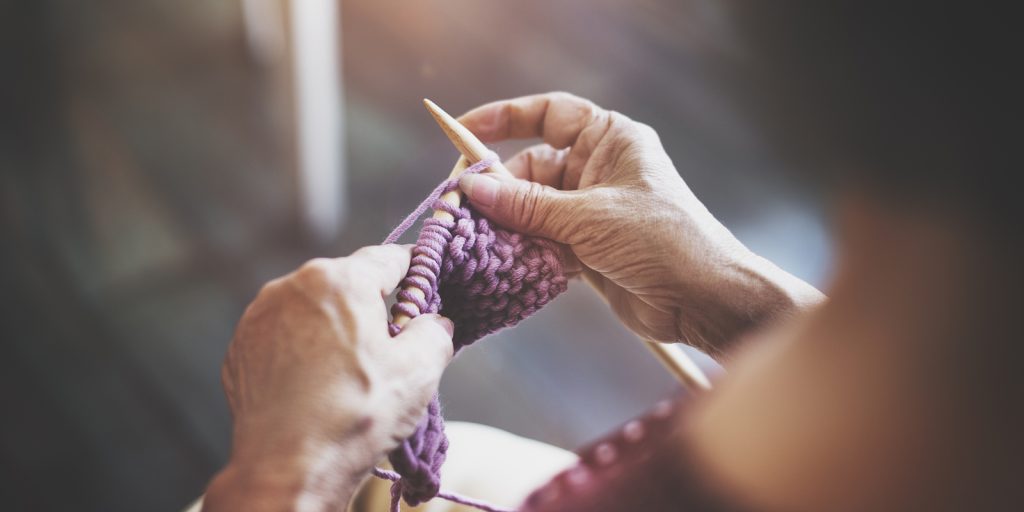
Grandma Hobbies: A Pathway to Health and Happiness


The concept of self-care has become an increasingly popular and accepted phenomenon in American society. Many adults are trying to prioritize recreational tasks, leisure activities, and hobbies to promote their well-being. Included in this culture shift is the promotion of “grandma hobbies” (Lascala, 2025). Under this category are activities such as knitting and sewing, crochet, birdwatching, gardening, baking, coloring, and reading. Behavioral activation – choosing to engage in activities to improve health – has many benefits for older adults (Janssen et al., 2023). Various psychological studies have supported the theory that these “grandma hobbies,” specifically, can increase mental and emotional well-being. Of course, these practices and their benefits can be applied to all of us, though “grandmas” may lead us by example. 

Knitting, sewing, and embroidery are all projects that involve motor skills, focus, and a sense of accomplishment. These hobbies can be practiced in an individual setting as well as in a social setting. Knitting among peers has been shown to increase one’s sense of belonging, and the act itself helps one to achieve a sense of competence (Nordstrand, Gunnarsson, & Häggblom- Kronlöf, 2024). The calming effect for those who engage in this hobby can lead to reductions in anxiety, depression, stress, and pain (Nordstrand et al., 2025). These simple tasks can also increase self-efficacy and a sense of control in one’s life when one feels a lack of control elsewhere (Nordstrand et al., 2025). The repetitive movements of the hands and focus on the task have been shown to create a meditative state among knitters, resulting in reduced anxiety, heart rate, and cortisol levels (Meehan, McCulloh, & Schlamb, 2025). 

Continue reading “Grandma Hobbies: A Pathway to Health and Happiness”

On Time

We mark our moments with clocks, dates, and calendars. We try to fix our experiences in time and memory. But time has a way of eroding, distorting, and transforming experience, especially its memory. Some people jokingly call the recollection of the past revisionist history. Memoirists will tell you about the moment when their lives seemed to become fictional. Memories fade, blur, refocus suddenly, even reappear in dreams. We think about our memories because, in a deep sense, they are us.

We take a history from our patients—timelines from the past. Many of us working in hospitals and clinics, as well as when completing insurance forms, are asked whether the patient is oriented to time, place, and person (oriented x 3). It’s important that we prioritize orientation in time. Perhaps this temporal orientation is the anchor in a sea of time, and we hold on to it above all else. Some of us rely solely on observable behavior or reported feelings rather than a detailed history. 

Some of us take a family history and create a genogram. We all observe and listen. Some of us hear a story, a narrative, a collection of themes we connect to other pieces of knowledge. All of us struggle to understand each other. Regardless of our theoretical approach, most of us gather some form of history. It guides and shapes us. Even psychologists mainly focused on a person’s current behavioral problems need to take at least a brief history to place the behavior within a time context. Every individual we meet tries to revisit past times through storytelling. Our work also takes place over time, and our own memories echo (counter transference) as we follow the narrative. Years ago, at a V.A. Clinic, I asked veterans to recall their parents’ disciplinary styles. “Well, how do we know if it’s true?” someone asked. “It’s all that’s left,” I answered. I then asked the veterans to describe how they disciplined their own children, and indeed, there was a similarity between their memories of their parents and their own reported behaviors. It was all that was left, literally.

Continue reading “On Time”

Senior Journeys: Changing the World

Hugh Pates, Ph.D. (left) with his brother Bishop Richard Pates (right) in Malawi.


Retired Bishop Richard Pates and his brother, local psychologist Hugh Pates, watched the native dancers in their bright tribal garments. People were happy and enthusiastic, and they had every reason to be, as they were celebrating a new boarding school that housed faculty and two hundred students. Many of the coed students were unfamiliar with how to use the shower and toilet when they first arrived at the school, and others were worried that a protective wall surrounded the school to shield them from potentially dangerous groups of men.

So where were the Pates brothers, and what was their role in all of this? The answer to the first question was Malawi in East Africa. A country with 21 million people, Malawi is the second poorest in the world, with 70% of its population living below the poverty line. Outside the few urban areas, there is little or no electricity or farm machinery, though much of the population tends small farms. Irrigation is primitive, and the population is largely uneducated.

Continue reading “Senior Journeys: Changing the World”

Home Run


People often seek a home run as their primary source of fulfillment. We enjoy big trips, cash bonuses, and dinners at fancy restaurants. Who doesn’t feel pride when their son or daughter gets into the college they want? When a daughter scores two goals in a soccer game, what parent isn’t proud? Awards and honors are the extra treats that bring us joy. These moments, rightly so, give happiness and purpose, and they are essential. But home runs are rare, and most of us live in the world of singles and maybe a double now and then.

Ongoing contentment is essential for a satisfying life, but it’s more easily disrupted by what’s missing than by what’s gained. Sometimes, a small mishap can throw everything off course. When your garage door opener breaks down, how do you feel after a long day? What about when your internet goes out or your car won’t start? Life runs smoothly when everything is going well, but a tiny change can make a big difference. Like a splinter, a minor problem can disturb life’s balance. A twisted ankle, a stubborn cough, and construction noise can all disrupt normal functioning.

When things are in harmony, we often overlook them and focus on the big wins or the absence of setbacks. Valuing what is normal and familiar is crucial because it underscores the importance of maintaining balance in life. Smoothness feels good, but it can vanish suddenly. Cherish it!

Happy Holidays?


We are supposed to be happy during the holidays. After all, Santa is cheerful, bright colors fill the scene, gifts are exchanged, and Christmas and New Year’s parties are everywhere. People say, “Merry Christmas” and “Happy New Year,” not “Depressed New Year.” Even Scrooge turns around in the end. So why do so many adults struggle to get through the holidays without feeling down, depressed, sad, or lonely?

Part of the problem is that adults are the ones managing Christmas, not the beneficiaries, as they were in their childhoods. After reaching a certain age, Christmas can never feel the same for many people. The magic of waking up to presents, a beautiful tree, and a cozy fire (if you live in New England!) is now replaced by hurried shopping for gifts, paying bills, and trying to balance work with holiday commitments. Reminiscing about an idealized past can bring about feelings of painful nostalgia, sadness, and loneliness.

The New Year, in some ways, brings the promise of better things to come, but it also stirs feelings about past failed expectations and disappointments. It emphasizes the passage of time and the fleeting nature of life. Alcohol during this time becomes a celebratory lubricant and a way to escape sorrows temporarily.

Here are some tips to help with managing the holidays.

  1. Don’t expect too much.
  2. Try to figure out what you truly want, not what marketers tell you to want. It’s okay to stay home on New Year’s Eve and go to bed by 10:00 P.M. 
  3. Go easy on the alcohol.
  4. You don’t have to spend a lot of money.
  5. Keep working out.
  6. Establish traditions with your own family and group of friends.
  7. Remember those who have gone.
  8. Setting goals for the new year is a good idea, but they need to be realistic. Set them in three-month intervals, at which times they can be reviewed and revised.
  9. Be kind and generous to others; the holiday spirit is what truly matters.

Age Has Sneaked Up on Me


My aging has sneaked up on me
Uncovering fragility
Making plain my mortality
To help me see reality

Why was I blind to death’s approach
As all my aches and pains encroached?
Or when my sacroiliac
Left me stricken, and out of whack?

Should I have felt my knees’ complaint
When piercing pain caused me to faint,
Or seen red flags when weakened sight
Produced halos from cars’ bright lights?

Continue reading “Age Has Sneaked Up on Me”

Happy Mother’s Day


I recently lost the love of my life, my husband Bill, to Alzheimer’s. We were married for over fifty years and had an absolutely wonderful life together. I have been really struggling with his loss. I can’t seem to pull out. So much of my life centered around him and I have had great difficulty re-establishing a life on my own. It is as though I have no internal resources, no inner voice to center me and guide me.

My daughter April sent me a remarkable letter for Mother’s Day. She reminded me that in the Jewish culture it is customary to wish someone “Live To 120” that means a hope that they will live not only a long life (like Moses) but also a life of quality and vitality. She remembered in her letter things I would say to her and her sisters to help them with the vicissitudes of life.

“Be your own cheerleader”.

“Make your own happiness”.

“Remember that nothing is life and death, except for life and death”.

Continue reading “Happy Mother’s Day”

Later-Life Transitions:

Moving to a Senior Facility

In 2023/2024, the SDPA Aging Issues Committee produced six ninety minute Zoom presentations entitled Later-Life Transitions Luncheon Series. Topics covered in this series included Retirement, Loss of Physical Capabilities, Moving to a Senior Facility, Becoming Caregiver to a Family Member, Loss of a Spouse/Partner and The Final Transition. We are presenting a summary of the material covered in each of the six series presentations in installments .

The third topic Moving to a Senior Facility was facilitated by Cynthia A. Cotter, Ph.D. and Kenneth S. Dellefield, Ph.D. on June 16, 2023.

MOVING TO A SENIOR FACILITY

In this session, Drs. Dellefield and Cotter discussed the experiences of older adults who find themselves having to leave their family homes and move to senior facilities.  The transition to a senior facility can be particularly difficult for many older adults to navigate.  There are stresses leaving the living environment one has known for many years and that has been incorporated into one’s sense of identity, safety, and place in the world.  It feels as though so many memories are being left behind.  The transition can be complicated by financial and tax issues and tremendous problems in downsizing.  Desires and competitions among family members can make matters even worse.  

You may be interested to know that, currently, 80% of those over the age of 50 own their own homes. And of those, 51% have no mortgages. So it comes as no surprise that 87% of adults over 65 say they do not want to move from their homes. They want to age in place. And yet many of those will find themselves unable to do so.

Continue reading “Later-Life Transitions:”

Successful Aging and Subjective Aging


In the United States, by 2034, older adults will outnumber children, and by 2060 older adults will represent nearly one quarter of the population (U.S. Census Bureau, 2018). An understanding of what contributes to successful aging will therefore have a significant impact. Historically, the concept of successful aging has been operationalized by objective markers such as the freedom from disease and disability, high physical and cognitive functioning, and social and productive engagement (Rowe & Khan, 1997). Recent research has aimed to determine subjective interpretations of what constitutes successful aging in order to provide a holistic perspective of aging that better accounts for lifestyle factors and psychological functioning (Jeste et al., 2010; Jeste et al., 2013). These elements include greater physical activity, fewer medical conditions, and absence from disability, arthritis, and diabetes (Depp & Jeste, 2006). In regard to psychological functioning and lifestyle factors, greater cognitive ability, increased social supports, the absence of depression, higher levels of education, productive engagement, access to wellness resources, valued relationships, religious activity, and high perceived meaningfulness were associated with successful aging (Depp & Jeste, 2006; Sunsanti et al., 2020). While physical health impairments and medical concerns are more prominent in the older adult population, psychological factors such as optimism and resilience have been shown to be more important for defining self-identified successful aging than physical functioning (Jeste et al., 2013). Similarly, psychiatric illnesses have been found to directly impact biological aging trajectories by diminishing psychosocial factors (e.g., variables related to lifestyle, psychological health, and social functioning) that would otherwise reduce risk of morbidity and mortality (Harmell et al., 2014).

Continue reading “Successful Aging and Subjective Aging”