
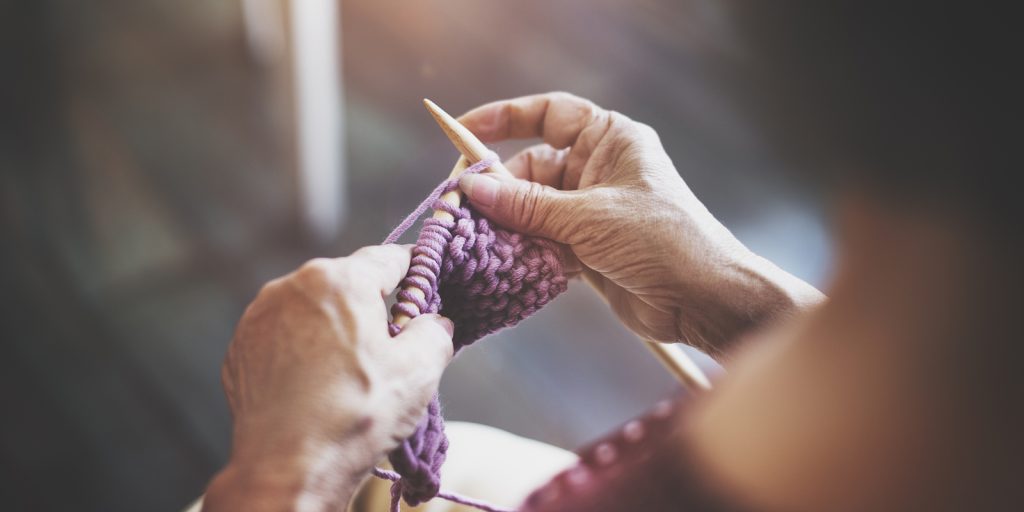
The concept of self-care has become an increasingly popular and accepted phenomenon in American society. Many adults are trying to prioritize recreational tasks, leisure activities, and hobbies to promote their well-being. Included in this culture shift is the promotion of “grandma hobbies” (Lascala, 2025). Under this category are activities such as knitting and sewing, crochet, birdwatching, gardening, baking, coloring, and reading. Behavioral activation – choosing to engage in activities to improve health – has many benefits for older adults (Janssen et al., 2023). Various psychological studies have supported the theory that these “grandma hobbies,” specifically, can increase mental and emotional well-being. Of course, these practices and their benefits can be applied to all of us, though “grandmas” may lead us by example.
Knitting, sewing, and embroidery are all projects that involve motor skills, focus, and a sense of accomplishment. These hobbies can be practiced in an individual setting as well as in a social setting. Knitting among peers has been shown to increase one’s sense of belonging, and the act itself helps one to achieve a sense of competence (Nordstrand, Gunnarsson, & Häggblom- Kronlöf, 2024). The calming effect for those who engage in this hobby can lead to reductions in anxiety, depression, stress, and pain (Nordstrand et al., 2025). These simple tasks can also increase self-efficacy and a sense of control in one’s life when one feels a lack of control elsewhere (Nordstrand et al., 2025). The repetitive movements of the hands and focus on the task have been shown to create a meditative state among knitters, resulting in reduced anxiety, heart rate, and cortisol levels (Meehan, McCulloh, & Schlamb, 2025).
Other hobbies that are typically done indoors and at home are baking, coloring, and reading. Psychological studies on baking and mental health have shown a positive relationship between baking and mental health. Baking can lead to increased personal growth and well-being (Ang, 2022). Studies have shown that baking has similar benefits and outcomes to art therapy, such as decreasing stress and anxiety, as well as increasing a sense of accomplishment and satisfaction (Ang, 2022). Coloring can also be an indoor activity that relaxes the mind and body, leading to emotional and mental benefits. One study among female college students found that coloring resulted in significantly lower levels of depression and anxiety after a one-week intervention (Flett et al., 2017). Coloring can also benefit one’s cognitive skills, such as improving working memory (Alaves, 2020). Reading for enjoyment has also been a common self-care activity. “Bibliotherapy” has been shown to help decrease anxiety and depressive symptoms among adults (Grewal & Peterkin, 2017). Reading can also be a social activity, with book clubs allowing more interconnectedness, intellectual discussion, and a sense of belonging.
“Grandma hobbies” involving the outdoors and nature can also improve one’s mental health. Engagement with nature, specifically birdwatching, has been shown to lead to increased psychological well-being (Peterson et al., 2024). The patience and focus involved with birdwatching, as well as immersion in nature, can mitigate feelings of stress, anxiety, and depression among adults (Peterson et al., 2024). Gardening is also an activity involving interaction with nature and the outdoors. Psychological research has repeatedly shown that gardening can reduce anxiety and depression symptoms (Clatworthy, Hinds, & Camic, 2013). The involvement with nature that gardening allows has been shown to increase positive affect, elevated mood, mindfulness, emotional resilience, and feelings of tranquility while decreasing stress levels (Pantiru et al., 2024).
Overall, some of these activities that have been associated with older adulthood have been shown to have many beneficial effects on mental and emotional well-being. This demonstrates the wisdom of choosing these activities. Studies have shown that these hobbies are not just helpful for mitigating psychological stressors in clinical populations but also in nonclinical populations. All adults, as well as children and adolescents, can benefit greatly from including these hobbies in their self-care routines and daily lives.
Authors: Nicole Weiss/Steven R. Thorp, Ph.D., ABPP.
Nicole Weiss is a second year Clinical Psychology PsyD doctoral student at Alliant International University-San Diego. She received her B.A. in Psychology at Colgate University. She is currently training at the Center for Applied Psychology Services and Alpine Treatment Center. She has a special interest in trauma work, specifically sexual violence prevention and support. She worked as a Certified Advocate and Counselor for The Rowan Center, a sexual violence resource agency in Stamford, CT, before coming to Alliant.
Steven R. Thorp, Ph.D., ABPP, completed his doctoral training at the University of Nevada, Reno, and worked as the Program Director for San Diego VA PTSD Clinic and as a tenure-track professor at UCSD. He has strong interests in assessment and treatment of PTSD, older adults and military populations, traditional and third-wave CBTs, stigma about mental health, and the use of technology to enhance mental health services. He is a Distinguished Professor at the California School of Professional Psychology (CSPP) at Alliant International University in San Diego.
References
Alaves, G. (2020). Remember to color: How coloring impacts elderly mental health and working memory. UNF Graduate Theses and Dissertations. 937. https://digitalcommons.unf.edu/etd/937.
Ang, C. (2022). Edible art: Baking as a modality in art therapy and its therapeutic benefits. School of Art Pratt Institute Theses and Dissertations. https://www.proquest.com/docview/2695865138?fromopenview=true&pq- origsite=gscholar.
Clatworthy, J., Hinds, J., M. Camic, P. (2013), Gardening as a mental health intervention: a review. Mental Health Review Journal, 18(4), 214-225.
Flett, J. A. M., Lie, C., Riordan, B. C., Thompson, L. M., Conner, T. S., & Hayne, H. (2017). Sharpen your pencils: Preliminary evidence that adult coloring reduces depressive symptoms and anxiety. Creativity Research Journal, 29(4), 409–416.
Janssen, N. P., Oude Voshaar, R. C., Wassink-Vossen, S., & Hendriks, G. J. (2023). Functional improvement by behavioural activation for depressed older adults. European Psychiatry, 66(1), e62.
Lascala, M. (2025). Why “grandma hobbies” could be the secret to better mental health. Good Housekeeping. https://www.goodhousekeeping.com/life/a64174154/grandma-hobbies/.
Meehan, C., McCulloh, J., & Schlamb, C. (2025). Therapeutic knitting as a strategy to reduce anxiety in nursing students. Nursing Times [Online]; 121(4).
Nordstrand, J., Birgitta Gunnarsson, A., & Häggblom-Kronlöf, G. (2024). Promoting health through yarncraft: Experiences of an online knitting group living with mental illness. Journal of Occupational Science, 31(3), 504–515.
Panțiru, I., Ronaldson, A., & Sima, N. (2024). The impact of gardening on well-being, mental health, and quality of life: an umbrella review and meta-analysis. Systemic Review, 13, 45.
Peterkin, A., & Grewal, S. (2017). Bibliotherapy: The therapeutic use of fiction and poetry in mental health. International Journal of Person-Centered Medicine, 7(3), 175-181.
Peterson, M. N., Larson, L. R., Hipp, A., Beall, J. M., Lerose, C., Desrochers, H., Lauder, S., Torres, S., Tarr, N. A., Stukes, K., Stevenson, K., & Martin, K. L. (2024). Birdwatching linked to increased psychological well-being on college campuses: A pilot-scale experimental study. Journal of Environmental Psychology, 96, 102306.